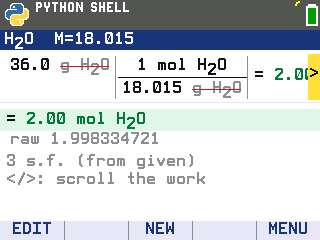
A stoichiometry calculator for the TI-84 Evo, made by Aditya. Type a compound, give an amount in grams, moles or particles, and it converts to the unit you ask for, for the whole compound or one element in it. The answer comes with the work: each conversion factor written out, the way your teacher sets it up.
By Aditya. Original release page
Send it to your calculator
Nothing listed in the connect popup: the calculator has to be plugged in and switched on to appear. Wake it up, check the USB cable (charge-only cables won't work), or move to a different port. Close any other tab that's using the calculator.
Open it on the calculator
- Press the
prgmkey. The PROGRAMMING menu opens.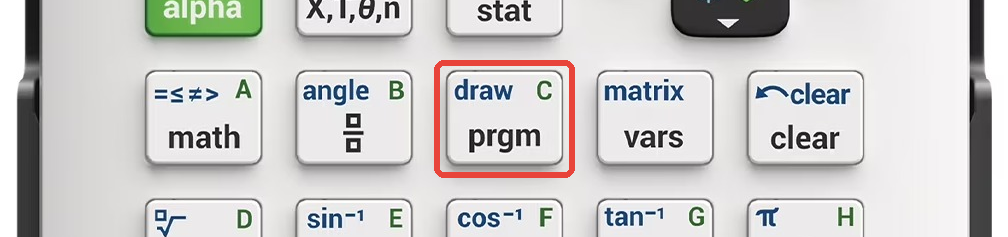
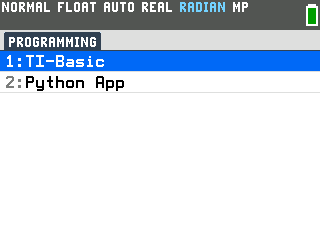
- Select Python App. Its file list opens.
- Press the down arrow until STOICH is highlighted.
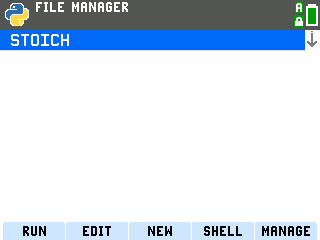
- Press
enterto run it. Its menu opens.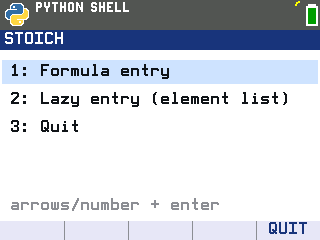
Solve a problem
These steps find how many moles are in 36.0 g of water.
- Select Formula entry. The formula line opens, ready for letters (ABC in the corner).
- Press
÷, the key with the green H. Each key types its green letter, and a letter that starts more than one symbol opens a short list.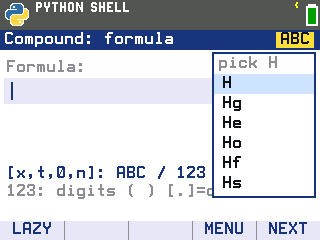
- Press
enterto pick H. - Press
x,t,θ,n, then2. Thex,t,θ,nkey switches between letters and numbers, so the formula reads H2. - Press
x,t,θ,n, then7(the green O), thenenter. The formula reads H2O. - Press
graph(NEXT). The problem screen opens with grams as the given unit and moles as the one to find. - Type
36.0.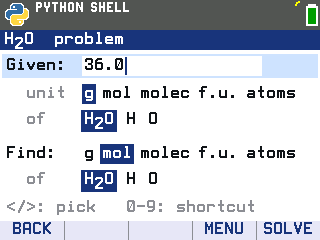
- Press
graph(SOLVE). The answer is 2.00 mol of H2O, under the conversion that gets there: 36.0 g times 1 mol over 18.015 g.
The answer keeps as many significant figures as the value you gave.
What else is in it
- Other units: on the problem screen, up and down move between the rows and left and right pick grams, moles, molecules, formula units or atoms.
- One element in a compound: the "of" rows list the compound and each of its elements, so it can find, for example, the grams of hydrogen that go with 1.00 g of nitrogen in NH3.
- Lazy entry on the menu takes the elements first, then how many of each.
- Hydrates: the
×key types the dot, as in CuSO4·5H2O.
For the molar mass and percent composition of a formula, the Molar Mass Calculator program works it out from the formula you type.