Type a chemical formula and this program gives you its molar mass in g/mol, plus the percent by mass of each element.
By CalcPlex.
Send it to your calculator
Plug the calculator into your computer with a USB cable, then use the button below. If something is not working, see troubleshooting.
Checking your browser…
Open it on the calculator
- Press the
prgmkey. The PROGRAMMING menu opens.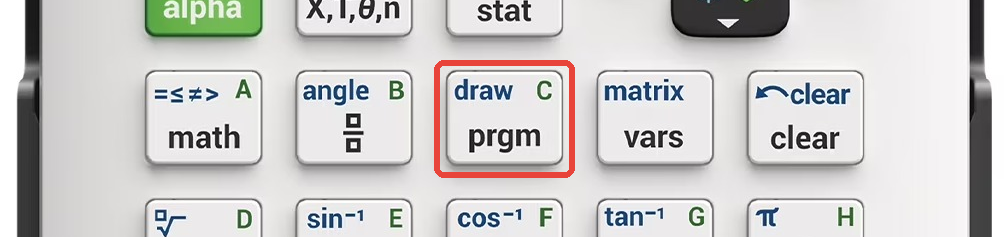
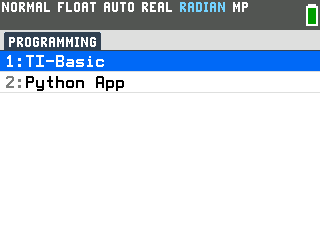
- Press
enterto select TI-Basic. The list of TI-Basic programs opens.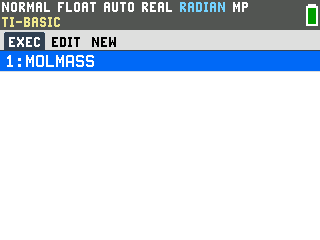
- Press
enteron MOLMASS in the program list, which puts prgmMOLMASS on the home screen. - Press
enterto run it. The program asks for the formula.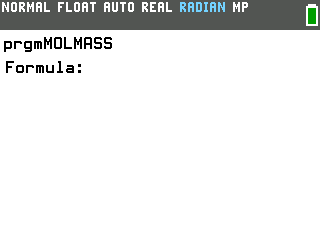
Find a molar mass
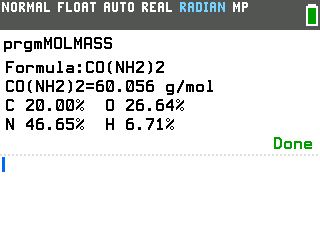
Find the molar mass of urea, CO(NH2)2.
- Type CO(NH2)2 in capital letters. Press
alphabefore each letter. The calculator has no lowercase letters, so formulas go in as capitals.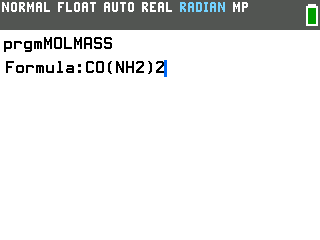
- Press
enter. In capitals, CO could be carbon and oxygen or cobalt, so the program asks which one you mean.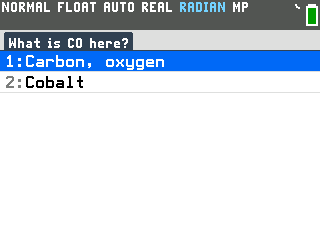
- Select Carbon, oxygen. The answer prints as
CO(NH2)2=60.056 g/mol, with the percent by mass of carbon, oxygen,
nitrogen and hydrogen under it.
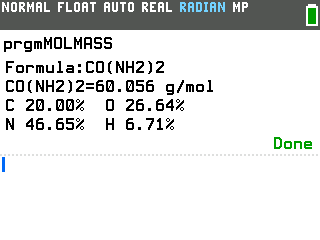
The answer line shows the formula the way the program read it, in normal case, so you can check it before you copy the number down.
To do another formula, press enter on the home screen right after an answer. The program runs again.
Good to know
- It asks whenever capitals could mean two things. That happens with
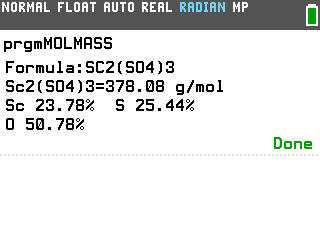
CO, CS, SC, NI, OS and BI. For Sc2(SO4)3, type
SC2(SO4)3 and select Scandium to get 378.08 g/mol.
- The molar mass stays in Ans for mole problems. To find the mass of
2.86 mol of Co(NH3)6Cl3, type CO(NH3)6CL3, select
Cobalt, then press
×2.86enter. That gives 764.96 grams. Going the other way, divide your grams by M, which also holds the molar mass.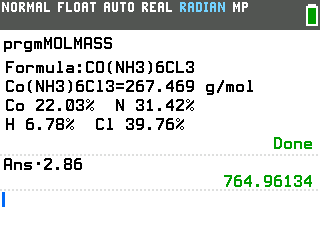
- Hydrates and complex ions work too. Use the
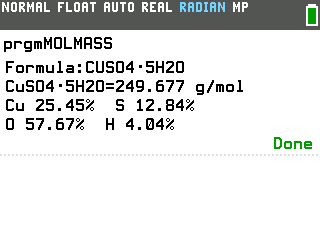
×key for the dot in a hydrate: CUSO4×5H2O comes back as CuSO4·5H2O, 249.677 g/mol. Square brackets (2ndthen−,2ndthen+) count as parentheses, so K3[FE(CN)6] gives 329.247 g/mol for K3[Fe(CN)6].